_edited.png)
Hawaii How to Choose a Faculty-Led Travel Program Provider: A University Administrator's Guide
Aug 17
4 min read
Julia Troccoli/August 2026
Faculty-led programs are among the most operationally complex things a university runs. You are coordinating faculty availability, student enrollment, visa requirements, local academic partners, accommodation, ground transport, safety protocols, and real-time logistics -- often across multiple cities or countries. The moment something breaks, it breaks in public, with students present.
Choosing the right program management partner is the single highest-leverage decision a program director makes. Here is exactly what to evaluate.
What Does a Faculty-Led Program Provider Actually Do?
There is a meaningful difference between a tour operator and a faculty-led program management company. Tour operators build fixed itineraries and sell group slots. Program management companies build custom academic programs from the ground up, integrating course learning objectives with local partners, site visits, and structured engagements.
The distinction matters because faculty-led programs are not group tours with homework. They are academic products. A provider that treats them as logistics exercises misses the academic design layer entirely.
The right partner handles:
Pre-program curriculum alignment and itinerary design
Local partner sourcing and vetting
Site inspections and contingency planning
Student enrollment support and pre-departure logistics
Multi-location ground coordination -- transport, accommodation, sequencing
On-site program management throughout the trip
Post-program evaluation and reporting
If a provider cannot do all of these, the program director fills the gaps.
The Real Test: Building in a New Destination
The most revealing question you can ask a prospective provider is this: can you build a program somewhere you have never operated before?
Any provider with an established catalog can run programs in destinations they already know. Very few can build from scratch. Building in a new destination requires the ability to identify and vet academic-quality local partners from a cold start, on-the-ground site inspection capability before student arrival, and local logistics networks for ground transport, accommodation, and emergency response.
This capacity is what separates providers with genuine operational infrastructure from those with a fixed portfolio.
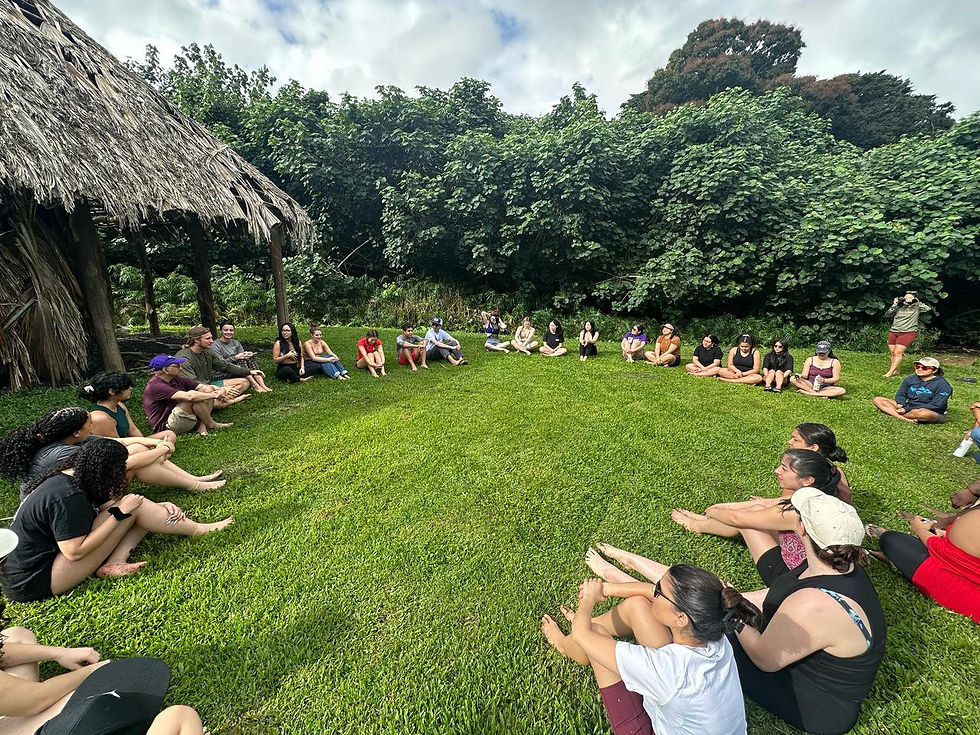
When a large private U.S. business school needed a domestic alternative to an international immersion program -- with no existing partner network in Hawaii -- Destination Partners built the program from scratch. That meant sourcing taro and cacao farming partners across Oahu and the Big Island, conducting full site inspections on both islands, and managing multi-island logistics end-to-end. The pilot ran successfully, and the school adopted it for repeat cohorts. Read the full Hawaii case study.
On-Site Program Management: The Line That Changes Everything
There is a fundamental difference between a provider that sells you an itinerary and a provider that sends someone with you.
On-site program management means a dedicated staff member travels with the group for the full duration. This person handles real-time logistics, vendor relationships, schedule changes, student welfare issues, and faculty requests. They are not a tour guide. They are a program operator.
Without this, faculty bear the operational load. Faculty are subject matter experts, not logistics coordinators. When flights change, when a partner cancels, when a student has a medical issue, the program director should be focused on the academic experience -- not on renegotiating with a bus company.
The best providers make on-site management a standard offering, not an add-on.
Multi-Location Logistics: Where Complexity Compounds
Faculty-led programs increasingly span multiple cities, regions, or countries within a single trip. A business school immersion might move across two islands. A sustainability program might cover three coastal ecosystems. A global health program might cross an international border mid-trip.
Multi-location programs require sequenced partner scheduling across locations, coordinated inter-city transportation, accommodation blocks managed in parallel, and contingency planning at every transition point.
The complexity compounds at each transition. A provider with strong single-destination execution may not have the coordination infrastructure for programs involving two or more logistically distinct locations. Ask specifically about their experience with this kind of program before committing.
Partner Quality: Academic Fit, Not Just Availability
Local partners are the substance of a faculty-led program. Farm visits, industry briefings, NGO workshops, cultural immersions -- these experiences are what students take home. A provider that sources partners based on availability rather than academic fit is building a tourism product, not an educational program.
Evaluate partners on three dimensions:
Academic alignment -- Does the partner's work connect directly to course learning objectives?
Engagement quality -- Can they deliver substantive, interactive experiences rather than a one-way presentation?
Reliability -- Have they worked with academic groups before? Do they understand the scheduling demands and group dynamics of university programs?
Ask providers how they vet partners and whether they personally visit sites before booking them. For first-time destinations, site inspection is not optional.
Program Planning Insights
What distinguishes a faculty-led program management company from a tour operator? A program management company builds custom academic itineraries aligned to faculty learning objectives, sources and vets local academic partners, and provides dedicated on-site staff throughout the trip. A tour operator provides logistics for pre-built itineraries. Faculty-led programs require the former.
How do providers build programs in destinations where they have no existing network? Strong providers conduct systematic local partner outreach, perform on-site site inspections before the program runs, and build relationships with farms, businesses, NGOs, and cultural institutions that can deliver substantive academic experiences. The provider absorbs the development work; the university gets a ready-to-run program.
What should I expect from on-site program management? A dedicated program manager travels with the group for the full duration. They handle real-time logistics, vendor coordination, schedule adjustments, and student welfare -- freeing faculty to focus on teaching and student engagement.
Can domestic U.S. destinations offer the same academic value as international programs? Yes, when designed around genuine academic content. Destinations with distinct cultural economies, industries, or ecosystems -- Hawaii's agricultural sector, for example -- offer substantive learning experiences unavailable in typical academic settings, without the complexity of international travel logistics.
How long does it take to develop a faculty-led program in a new destination? For established destinations, 6-12 months. For new destinations requiring partner development and site inspections, allow 12-18 months. Programs built with less lead time tend to have weaker partner quality and higher operational risk.


Comments